Imagine walking into a doctor's clinic and saying,
"Doctor, I think I need antibiotics."
A good doctor is unlikely to write a prescription immediately. Instead, the doctor begins with questions.
"What seems to be the problem?"
"How long have you been experiencing it?"
"Do you have any allergies?"
"Have you taken any medication already?"
Only after understanding the problem does the doctor decide on the treatment. The prescription is the outcome of the diagnosis.
Now let's step away from healthcare and think about our finances. Many of us do exactly the opposite.
We begin with questions like:
"Which mutual fund should I invest in?"
"Is this insurance policy good?"
"Should I buy gold?"
"Which investment will give me better returns?"
Notice something?
Every question begins with a financial product. Very few begin with a financial decision.
Products Are Important... But They Come Later
A mutual fund is a product.
A fixed deposit is a product.
Gold is a product.
An insurance policy is a product.
None of them are inherently good or bad.
Their suitability depends entirely on the reason they are chosen. Think of it this way.
A hammer is an excellent tool.
But not if you need to tighten a screw.
The problem isn't the hammer.
The problem is using the wrong tool for the job.
Financial products work exactly the same way.
The right product in the wrong situation can still lead to the wrong outcome.
So, What Is a Financial Decision?
A financial decision is the thinking that happens before the investment.
It begins with questions such as:
• Why am I investing this money?
• When will I need it?
• What happens if things don't go as planned?
• What level of uncertainty am I comfortable with?
• Which option best supports my financial objective?
Notice that not one of these questions asks about returns.
Not because returns are unimportant.
They absolutely matter. But returns should be the result of a well-thought-out financial decision—not the starting point of one.
A Simple Example
Imagine two friends, Amit and Rahul.
Both invest in exactly the same mutual fund on the same day.
A year later, the fund has delivered the same return to both.
Does that mean both made a good financial decision?
Not necessarily.
Amit invested money that he would not need for many years.
Rahul invested money he was planning to use for a major family commitment in the near future.
The product was identical.
The returns were identical.
But the decisions behind those investments were completely different.
One investment may have been aligned with the investor's objective. The other may not have been.
That's the difference between choosing a product and making a financial decision.
The Question We Should Ask First
Perhaps we've been asking the wrong question all along. Instead of asking,
"Which investment offers the best returns?"
What if we first asked, "What am I trying to achieve, and what is the best way to get there?"
It's a small change in the question.
But it can completely change the answer.
A Different Way of Looking at Investing
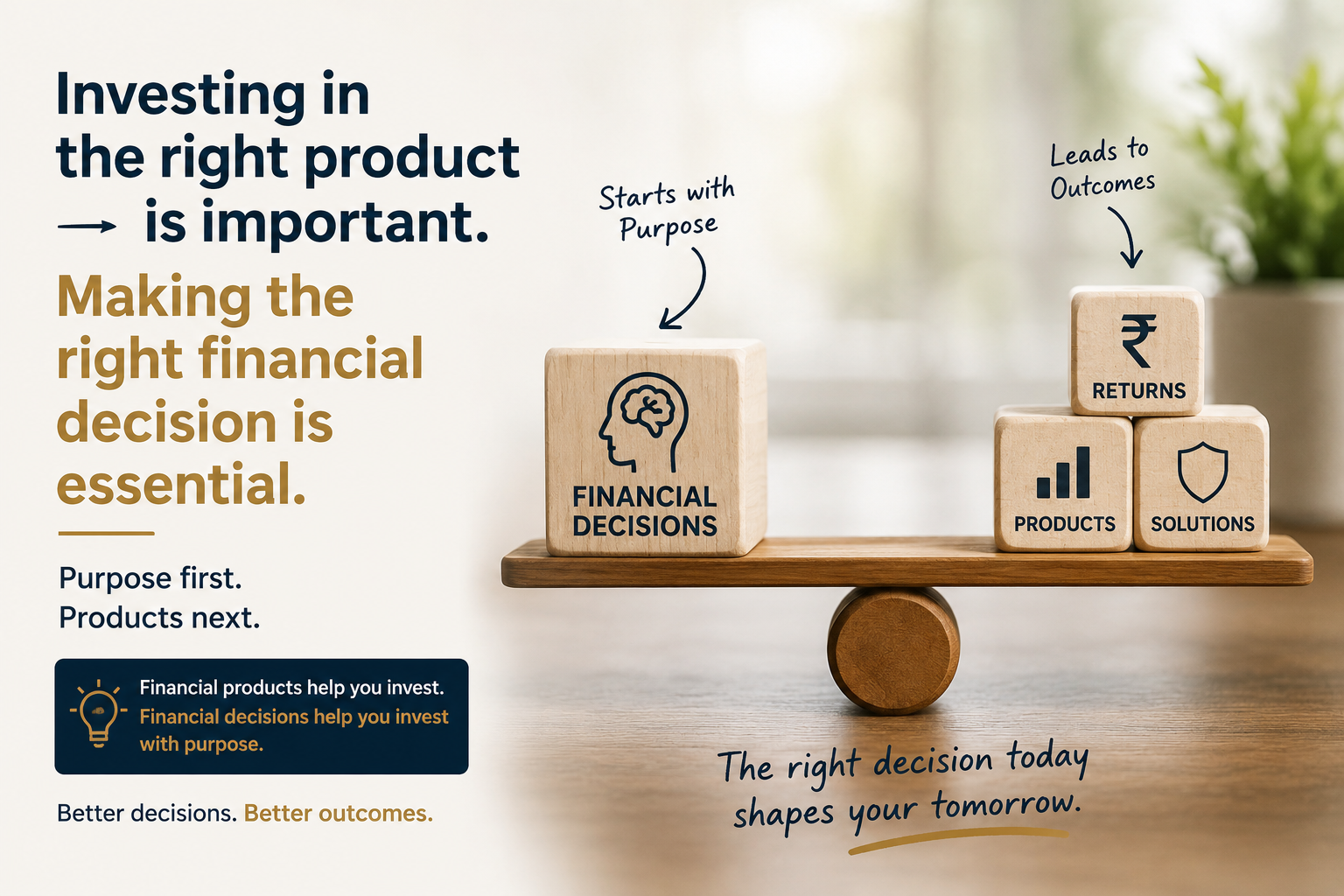
Financial products help us invest.
Financial decisions help us invest with purpose.
One is a tool. The other is the thought process that determines which tool is appropriate.
Because at the end of the day, people don't achieve their financial goals simply because they bought the right product.
They achieve them because they first made the right financial decisions.
At JM Solutions, we believe that every financial product should be the outcome of a thoughtful financial decision—not the starting point of one.
Because every investment begins with a decision. And better financial decisions create better financial outcomes.
Related Articles