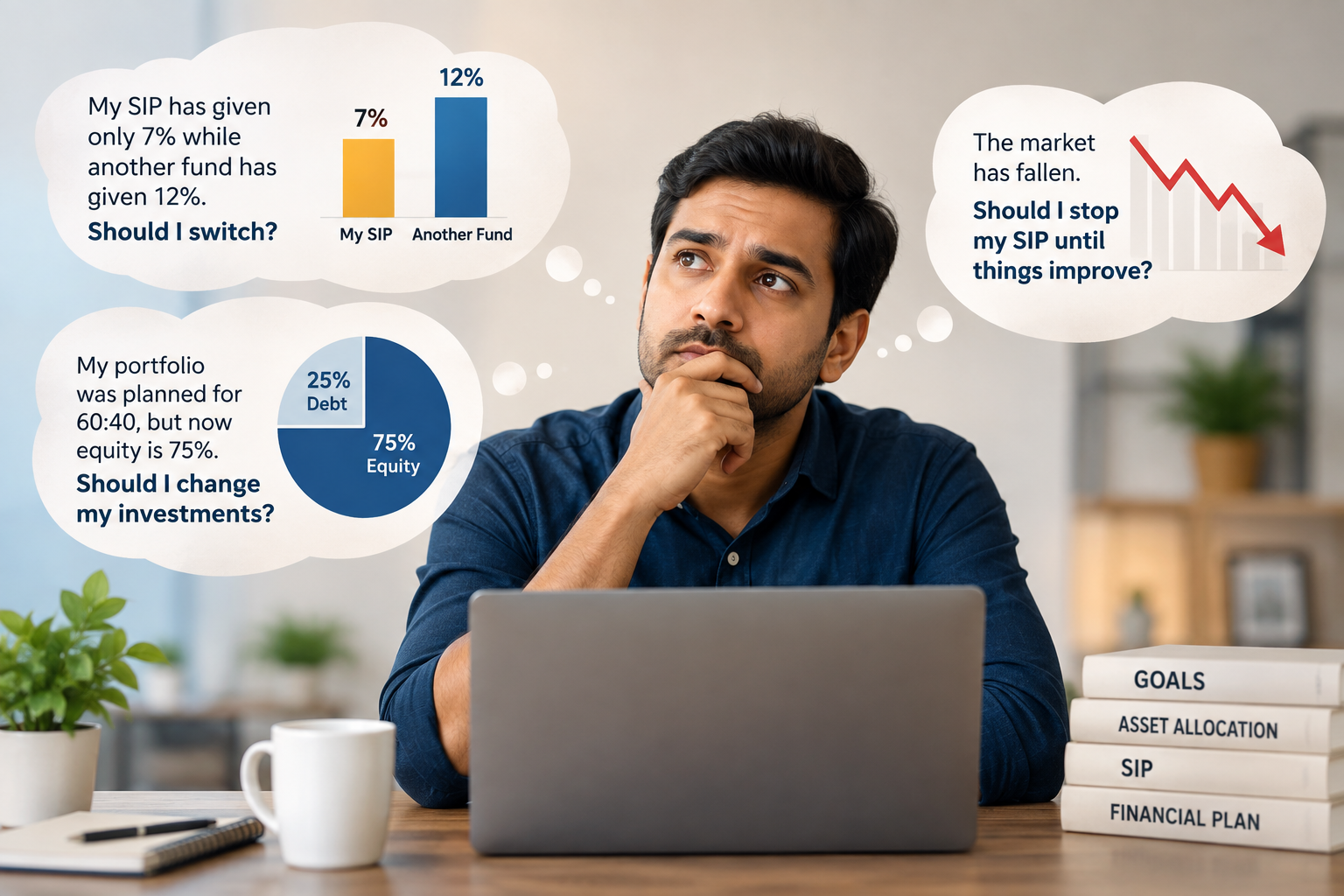
"My SIP has given only 7% while another fund has given 12%. Should I stop it?"
"The market has fallen. Should I pause my SIP and restart when things improve?"
"My portfolio hasn't performed as expected. Should I get a second opinion?"
These are genuine questions investors ask.
And after interacting with investors through 400+ financial literacy sessions, I have noticed that the answer is often not as simple as looking at recent returns.
Consider this example
An investor started a SIP five years ago based on his goal, time horizon, risk profile and the fund's investment approach.
After two years of strong market performance, another fund began delivering better returns.
He considered switching.
But when the portfolio was reviewed, the question was not "Which fund has performed better?"
It was:
"Have the reasons for which you selected your existing fund changed?"
If the answer is no, a temporary difference in performance may not justify a change.
Another example
An investor originally planned for a 60:40 equity-debt allocation.
After a strong equity market, equity grew to almost 75% of the portfolio.
Nothing was necessarily wrong with the individual investments.
But the portfolio had drifted away from the original allocation.
The solution may not be to replace a fund. It may simply be to rebalance.
And then comes the falling-market question
"Markets are correcting. Should I stop my SIP?"
This is where emotions can interfere with the basic principle of disciplined investing.
When markets fall, a fixed SIP amount buys more units.
Stopping the SIP because prices have fallen may mean stepping away precisely when the investment is purchasing at lower prices.
That doesn't mean every SIP should continue regardless of circumstances.
It means the decision should be based on your goal, asset allocation and the underlying investment—not simply the market situation.
So before you stop or switch, ask yourself:
Has my goal changed?
Has my asset allocation changed?
Have the fundamental reasons for selecting the investment changed?
Or am I reacting to recent performance?
If you're unsure, don't make the decision alone.
A second perspective can sometimes provide more clarity than another search for the "best-performing" investment.
We believe you should consider a second perspective on your existing investments for a financial review.
Because good financial decisions are not always about finding a new investment.
Sometimes, they are about understanding the one you already have.
Related Articles